

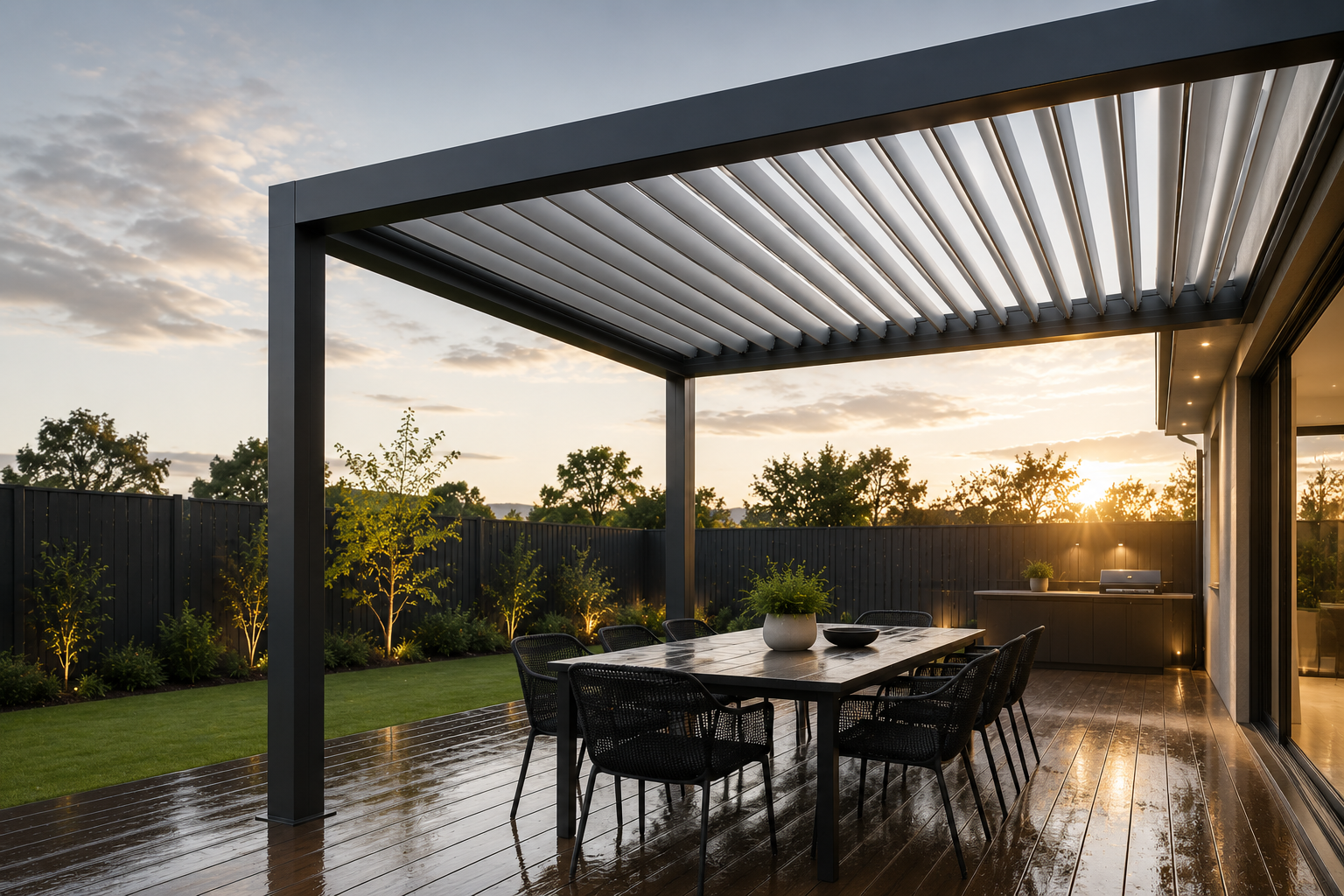
A BBQ area does not become comfortable just because it has a roof above it. The real test comes at 5:30 pm, when smoke starts moving, plates pass through the patio, and the late sun slips under the roof line. A well-planned outdoor pergola gives the space shade, but the better result comes from airflow, table distance, roof movement, cleanable surfaces and a layout that still feels easy when the grill is hot.
The practical idea
A BBQ pergola should not be treated like a decorative roof over paving. It should work like a calm outdoor room. The cooking edge needs breathing space, the table needs steady shade, and the roof should help smoke and heat leave instead of holding them above the chairs.
Why BBQ pergolas often feel wrong after the first few meals
A BBQ patio can look finished in a clean photo. The table is centred, the chairs are straight, and the roof sits neatly over the paving. However, real outdoor cooking is never that still. A lid opens, a tray needs a landing spot, someone pulls a chair back, and another person walks through with drinks.
That is when small layout errors become obvious. A post may sit just too close to the chair line. Smoke may drift across the table because the grill faces the wrong direction. The roof may cover the slab but miss the actual sitting position once chairs are pulled out.
The better way to plan an outdoor pergola is to begin with the meal. A normal BBQ has a rhythm: prep, heat, turning food, serving, sitting, clearing plates and staying outside after dark. The pergola should support that rhythm instead of simply filling a rectangle on the ground.
This is where many patio plans become too technical. Width, depth, colour and roof type matter, of course. Still, those details only become useful when connected to daily use. A roof can be the right size on paper and still feel wrong if the BBQ, side shelf and table all compete for the same walking path.
A quick reality check
Before choosing a pergola size, imagine one ordinary evening: the grill is running for 35 minutes, the table is set, and people are moving between the kitchen door and patio.
- If the cook blocks the only path, the layout needs more space.
- If smoke crosses the table, the cooking edge needs a better direction.
- If the chairs touch a post, the pergola footprint is not yet right.
A strong BBQ pergola plan feels quiet and practical. It keeps the hot work on one edge, gives the table real shade, lets smoke escape, and leaves a clean walking line between the house, grill and dining area.
Start with cooking and seating zones
A BBQ area works best when it has three clear zones. The first is the cooking edge, where the grill, tongs, hot tray, side burner and quick decisions live. The second is the serving path, which needs to stay open even when a chair moves. The third is the seating area, where shade, comfort and conversation matter more than fast movement.
In a compact patio, these zones may sit close together. Even so, they should not collapse into one crowded corner. The BBQ should not block the route from the kitchen door to the table. Also, the dining chairs should not sit so close to the grill that heat reaches someone’s back when the lid opens.
A simple tape test helps. Mark the BBQ footprint on the ground. Then mark the table with chairs pulled out, not tucked in. After that, walk from the house to the grill and then to the table while holding both hands forward, as if carrying plates.
If that route feels tight before the pergola arrives, posts will not make it better. In fact, posts usually make a weak layout more obvious. This is why the walking path should be checked before the final roof size is chosen.
A better BBQ zone usually passes these four checks
Chair movement
Chairs can slide back without hitting a post, planter, cabinet or BBQ side shelf.
Cooking clearance
The grill lid can open, and hot trays can move without crossing the sitting line.
Serving path
Food can move from kitchen to BBQ to table without a tight sideways shuffle.
Open airflow
Smoke has a cleaner way out instead of sitting under the roof or drifting over plates.
The cook’s body position also matters. A BBQ facing a blank fence can make cooking feel isolated. A BBQ facing straight into the table can send heat and smoke into the most relaxed part of the patio. Often, a slight angle works better because it keeps the cook connected without forcing smoke toward every chair.
The best layout does not always place the BBQ in the middle of the covered zone. In many homes, the grill works better near an open edge, while the main pergola footprint protects the dining area. That small shift can make the whole patio feel calmer.
Outdoor pergola BBQ flow: where the table, grill and roof should sit
An outdoor pergola BBQ layout should be judged by movement, not symmetry. A patio that looks balanced from above can still feel awkward when food is moving. The key is to stop the hot work line and the social line from crossing too often.
The hot work line includes the grill, prep shelf, side burner and any place where hot food is handled. The social line includes chairs, the table, lounge seating and the path to drinks. These two lines can meet at a serving point, but they should not fight each other every few minutes.
In a relaxed patio, the cook can turn, plate food and speak to the table without standing in the main walkway. The table sits close enough to feel connected, but far enough away from heat and smoke. Meanwhile, the pergola roof frames the dining area and gives the cooking edge partial shade without closing it in.
 View P180 Pro Pergola
A large patio can still feel messy if every activity sits in the middle. The BBQ should normally live on a working edge, not in the centre of the relaxed seating zone. This keeps the table more comfortable and leaves the lounge area cleaner after dinner.
For a long patio, the better order is often house door, serving point, table, and then garden or lounge space. For a square patio, the BBQ can sit along one side while the table takes the strongest shade. For a narrow courtyard, a wall-mounted structure may keep the centre path cleaner.
The useful rule is simple. The pergola should protect the part of the evening that lasts longest. Cooking may take 30 to 45 minutes, while sitting and talking may last two hours. Because of that, the table often deserves the most reliable shade.
Smoke and airflow under an outdoor pergola
Smoke is the detail that changes the mood quickly. One breeze from the wrong direction can push smoke across the table and make everyone shift seats. The food may still be good, but the patio no longer feels comfortable.
A louvred roof can help because warm air and smoke can rise when the blades are partly open. Yet the roof is not the whole answer. Side airflow matters just as much. If the BBQ sits between a house wall, a high fence and a closed screen, smoke has nowhere easy to go.
The practical goal is cross-flow. Air should be able to enter from one side and leave from another. When that happens, heat clears faster and smoke becomes less likely to sit under the roof. The patio feels lighter, especially during longer cooking.
A pergola for outdoor kitchen use should not feel sealed
A pergola for outdoor kitchen use should feel protected, not enclosed. Protection gives shade, rain cover over the table and a more complete outdoor room. Enclosure can trap heat, smoke and cooking smells.
Appliance clearances should come from the BBQ or outdoor cooking equipment manual. A grill lid, side vent, gas appliance, pizza oven or side burner may need specific spacing. This is not a detail to guess from a photo, because it affects comfort and safety.
Smoke direction test
Stand in the patio at the hour the BBQ usually runs. Late afternoon is better than morning because wind and sun often change by then.
- If smoke moves toward the table, shift the cooking edge closer to an open side.
- If the space feels boxed in, reduce side enclosure around the cooking zone.
- If the roof is doing all the work, the side airflow probably needs more attention.
Louvre direction can also help. The roof should support warm air as it lifts away from the cooking area. During a quick shower, the louvres can close when cooking has paused or when the dining area needs more cover. During active grilling, partial openness often feels better than closing the whole roof.
A good outdoor pergola does not try to turn a BBQ area into an indoor kitchen. It gives the patio structure while still letting the outdoor part behave like an outdoor space.
Shade without trapping heat
Shade is usually the first reason a patio gets a pergola. Still, shade alone is not enough around a BBQ. A roof can block direct sun and still make the area feel heavy if hot air sits underneath it. Paving holds warmth, the BBQ adds more heat, and a still corner can feel uncomfortable after only 20 minutes.
The better question is not “How much shade is there?” The better question is “Where does the heat go?” If the answer is nowhere, the design needs more openness. Adjustable louvres help because the roof can change during the day instead of staying fixed in one position.
Patio BBQ shade should follow the real sitting hours
Good patio BBQ shade follows the time the space is actually used. A patio may look fine at noon, but the real problem may arrive at 4:30 pm when low western sun cuts under the roof edge. That is when one side of the table becomes too bright, while the shaded side suddenly becomes the only place anyone wants to sit.
Therefore, the roof should not be planned only from a top-down drawing. The side angle matters. Furniture direction matters too. A long table turned one way may stay comfortable, while the same table rotated 90 degrees may put half the chairs in hard light.
 View P180 Pergola
The cooking area needs its own shade logic. The person at the grill should not stand in hard sun for 40 minutes. However, the grill should not sit so deeply under cover that smoke and heat collect above it. A partial-shade cooking edge often feels better than a fully covered corner.
Colour changes the mood as well. A grey pergola can feel grounded beside charcoal paving, darker furniture and black BBQ equipment. A white pergola can make a compact courtyard feel brighter, especially beside pale walls, light stone or coastal planting.
The best shade feels like relief. It cools the table, softens the glare and leaves the cooking area with enough air to breathe.
Roof operation and real BBQ weather
BBQ weather changes quickly. A bright afternoon can turn breezy around 4 pm. A light shower can arrive just as plates are set. Later, the air may cool, and the roof can feel better slightly open again. For that reason, roof operation deserves more attention than it usually gets.
Manual louvres suit simple routines. If the patio is compact and the roof only needs one or two adjustments, manual operation can be practical and clean. It can work well for smaller dining areas where the handle is easy to reach and the roof position does not change often.
Motorised louvres suit larger or more frequently used spaces. The benefit is not only convenience. It is timing. During cooking, the roof can stay partly open to release heat. During light rain, it can close over the table. Later, it can open again when cooking stops and the patio needs more air.
Manual or motorised: a practical way to choose
Manual louvres usually suit
Small patios, simple shade needs, less frequent roof changes and layouts where the control point is easy to reach.
Motorised louvres usually suit
Larger dining zones, regular entertaining, frequent weather changes and evening setups where quick adjustment feels natural.
This flexibility is one reason a louvred outdoor pergola often works better for BBQ patios than a fixed solid roof. A fixed roof gives one answer all day. A louvred roof can respond to lunch, smoke, rain and evening comfort in smaller steps.
Still, roof control should not be expected to rescue a poor layout. If the BBQ is boxed into a still corner, even a flexible roof will struggle. The roof works best when the base plan is already sensible.
Materials and cleaning around BBQ smoke
BBQ areas get dirty in a specific way. It is not only garden dust. It is smoke residue, fine grease, pollen, leaves, sauce splashes and the odd drink spill near the table. Because of that, material choice should be judged by how the patio feels after 20 meals, not only how it looks on day one.
Aluminium makes practical sense around outdoor cooking because it does not absorb moisture like timber. A clean aluminium frame also tends to be easier to rinse and wipe than a structure with heavy decorative grooves. Around smoke and food, simple lines are not boring. They are useful.
Cleaning should stay gentle. Regular cold-water rinsing helps remove loose dust from beams and louvres. Warm water with mild detergent can help with visible marks. Harsh chemicals are best avoided because they can affect finishes and create more maintenance later.
Keep the messy side and the soft seating apart
Soft outdoor seating can look excellent under a pergola, but it should not sit directly beside the smoke edge. Fabric holds smell more easily than a dining chair with a wipeable frame. A dining table can handle BBQ nights better when it sits in the shaded zone, while lounge seating stays slightly away from heat and smoke.
Paving affects daily comfort too. Light stone looks fresh, but oil marks show faster. Dark paving hides marks better, yet it can hold more heat in summer. A medium-toned surface often feels more forgiving because it balances appearance, heat and everyday mess.
Easy-care BBQ patio habits
- Rinse dust and loose residue before it builds up along beams or louvre edges.
- Keep grease trays and grill plates clean before residue spreads to paving.
- Leave enough empty floor space to move chairs and wipe surfaces easily.
- Avoid placing fabric lounge seating directly beside the main cooking edge.
Cleaning is part of design. A low-maintenance patio is not only about the pergola material. It is about leaving enough space to wipe tables, rinse paving, clear leaves and move chairs without turning the area into a weekend job.
Small patios and larger BBQ zones need different decisions
A compact BBQ patio needs discipline. It cannot hold a full outdoor kitchen, a large dining table, a lounge, planters and storage without feeling tight. In this kind of space, the pergola should protect the most useful zone and leave the floor feeling open.
A wall-mounted layout can work well when the patio sits directly outside the kitchen or living room. It can keep the structure connected to the house and reduce posts in the main movement area. However, wall condition, gutter height, door swing and drainage need to be checked before finalising the plan.
 View P120 Pergola
In a small patio, the better choice may be a slimmer table, a BBQ placed on the open side and a roof that protects the sitting area more than the entire slab. This feels more natural than forcing every feature under cover and losing the walking path.
A larger patio has a different problem. It can feel scattered. The BBQ, table and lounge may all sit too far apart, so the area stops feeling like one outdoor room. In that case, a larger pergola can help gather the space, but only if the zones are still organised.
Size decision guide
- For compact patios, protect the table and leave the cooking edge open enough for smoke movement.
- For medium patios, balance BBQ access, table shade and chair pull-back space before choosing the roof footprint.
- For larger patios, use the pergola to define one outdoor room instead of spreading furniture across empty paving.
- For awkward patios, consider custom sizing when standard dimensions almost work but miss a door, drain or furniture line.
The best size is not always the largest size. It is the size that makes the patio feel calm when the BBQ is running, chairs are moving and the table is already full.
Evening BBQ lighting should feel calm, not harsh
Many BBQ meals continue after the cooking stops. Plates are cleared, drinks stay on the table, and someone goes back to the grill one more time. At that point, lighting becomes part of the comfort of the space.
Harsh overhead light can make a patio feel like a workbench. Warm, even light feels better because it makes food, faces and paving look softer. It also helps the serving path stay visible without filling the roof line with loose fixtures.
Integrated LED strip lighting suits this kind of use because it follows the pergola frame. It keeps the structure clean and gives the dining zone a more finished evening feel. The aim is not to flood the patio with brightness. The aim is to make the outdoor room comfortable after sunset.
 View LED Strip Lighting
Lighting should follow movement. The serving path needs enough visibility for plates and steps. The BBQ edge needs practical light, but not glare into the seated area. The dining side needs a softer glow because people usually stay there longer.
It is easy to overdo lighting. A cleaner plan uses the pergola frame for the main glow, then adds small landscape or portable lighting only where the patio still feels dark.
Installation and site checks should happen before choosing the final size
Before the final pergola size is selected, the site needs a slow walk-through. The slab, wall condition, gutter line, drainage, door swing, steps, windows and nearby services can all affect the finished result. Around a BBQ area, appliance clearance and airflow need the same level of attention.
Everpergo does not directly provide installation services, but can recommend experienced installers and provide installation guides and technical support. That distinction matters because the product, site preparation and installation scope should stay clear before work begins.
Some smaller, straightforward projects may suit confident DIY work. However, larger spans, wall-mounted structures and patios with complex cooking zones often deserve experienced help. A small alignment issue can affect drainage, roof operation and the way furniture fits under the structure.
Height should also be checked early. The roof should feel open enough for smoke, heat and visual comfort. It should also clear doors, windows, nearby walls and any outdoor cooking equipment. If the pergola feels too low above the cooking edge, the whole BBQ area can feel compressed.
Site check before final order
- Check the slab, drainage direction and where rainwater will move during a short shower.
- Confirm door swing, window clearance, gutter line and wall condition for wall-mounted layouts.
- Mark the BBQ lid, side shelf and hot tray movement before confirming post positions.
- Plan electrical access early if motorised louvres or LED lighting will be included.
Drainage deserves the same practical attention. Rain should not fall where people step from the house, stand at the BBQ or pull out chairs. A BBQ patio sees repeated foot traffic in the same few places, so water movement should be planned around those paths.
Product path for BBQ patios
Everpergo focuses on all-aluminium louvred pergolas, including P120, P180 and P180 Pro options. The range includes manual or motorised louvre choices, freestanding or wall-mounted layouts, white and grey finishes, and custom size options. For a BBQ patio, the better product path starts with how the space works, then moves into model choice.
P120
A simpler option for compact patios where the table is small, the roof does not need constant adjustment, and the cooking edge stays close to an open side.
View P120 PergolaP180
A balanced choice for everyday BBQ patios where dining, shade, airflow and roof control need to feel practical without making the space heavy.
View P180 PergolaP180 Pro
A stronger fit for larger outdoor rooms where BBQ, dining and lounge zones need to feel connected while still leaving space to move.
View P180 Pro PergolaFor a compact BBQ corner, P120 can suit a smaller patio where the main need is simple shade, cleaner structure and a lighter footprint. It works best when the layout is disciplined and the table does not need a large covered zone.
For a balanced cooking and dining area, P180 is often the stronger middle path. It can suit patios where the pergola needs enough presence for everyday dining, but the space still needs to feel open and easy to move through.
For a larger entertaining area, P180 Pro makes more sense when the pergola needs to frame a wider outdoor room. This is the situation where a lounge, dining table and cooking edge all need to feel connected without crowding each other.
Better next step
Choose the pergola around BBQ movement, not around an empty slab
Start with the smoke path, table distance and chair movement. Then compare roof size, louvre operation and accessories with a clearer eye.
Explore the Outdoor Pergola Range View P180 PergolaThe Outdoor Pergola Range is the most natural next step when comparing size, roof operation and layout options. A practical BBQ area usually becomes easier to plan once the smoke line, table distance and louvre setup are considered together.
Extended reading
A BBQ-focused plan becomes easier when the wider backyard direction is clear. These pages help connect the cooking zone with the rest of the outdoor space, especially when the patio also needs dining, lounging or garden-facing shade.
Final planning notes for a BBQ area that feels easy to use
A BBQ patio should feel easy on an ordinary evening, not only in a clean photo. The cook needs space to turn. The table needs reliable shade. Smoke needs a route out. Chairs need room to move. These small details decide whether the patio becomes a place that gets used often.
The right outdoor pergola gives the space more than cover. It helps organise the outdoor routine: cooking, serving, sitting, clearing and staying outside after the food is gone. That is why the best decision starts with BBQ and dining flow, then moves into pergola size and roof setup.
- Mark the BBQ, table and pulled-out chair positions before choosing the final footprint.
- Keep the cooking edge near open airflow, and avoid placing soft seating in the main smoke path.
- Match roof operation to real use: manual for simple routines, motorised for larger BBQ and dining patterns.
Next step
Plan the BBQ + dining flow first, then choose the pergola size
The most comfortable BBQ patios usually begin with one simple question: where should the smoke, heat and people move? Once that answer is clear, roof size and louvre setup become easier to compare.
Compare Outdoor Pergola Options Start With P180 PergolaFAQ
Can a BBQ sit under a louvred pergola?
A BBQ can work within a pergola-planned patio when appliance clearance, open airflow and smoke movement are handled properly. The BBQ manual and local safety requirements should guide the final position. The space should not feel sealed, and smoke needs a clear route away from the dining area.
Is a manual or motorised roof better for a BBQ patio?
Manual louvres can suit compact patios and simple shade needs. Motorised louvres can feel more practical in larger BBQ and dining areas where the roof may change position during cooking, rain, low sun or evening use. The better choice depends on how often the roof needs adjustment during a normal meal.
How should smoke be reduced in an outdoor pergola BBQ area?
Smoke control starts with layout. Place the BBQ near an open side where possible, avoid enclosing every side around the cooking edge, and keep the dining table out of the main smoke path. Partly opened louvres can help warm air rise, but side airflow is still important.
What size pergola works best for an outdoor kitchen?
The best size depends on the cooking edge, table size, pulled-out chairs and walking route from the house. A pergola for outdoor kitchen use should leave space for safe cooking, serving and airflow. Custom sizing can help when the patio is narrow, irregular or already shaped around doors and garden paths.
Does Everpergo directly provide installation services?
Everpergo does not directly provide installation services, but can recommend experienced installers and provide installation guides and technical support. For BBQ patios, this support can help because post placement, roof setup, appliance clearance and everyday movement all affect the final comfort of the space.
What is the easiest way to plan patio BBQ shade?
The easiest method is to check the patio during the actual cooking time, not only at midday. Mark where the sun hits the table in late afternoon, then plan the roof and furniture around that pattern. Patio BBQ shade should protect the seated area while leaving enough open airflow around the grill.
Share:
Roofed Pergola for Small Patios Without Feeling Closed
Aluminium Pergola Maintenance for Australian Weather